
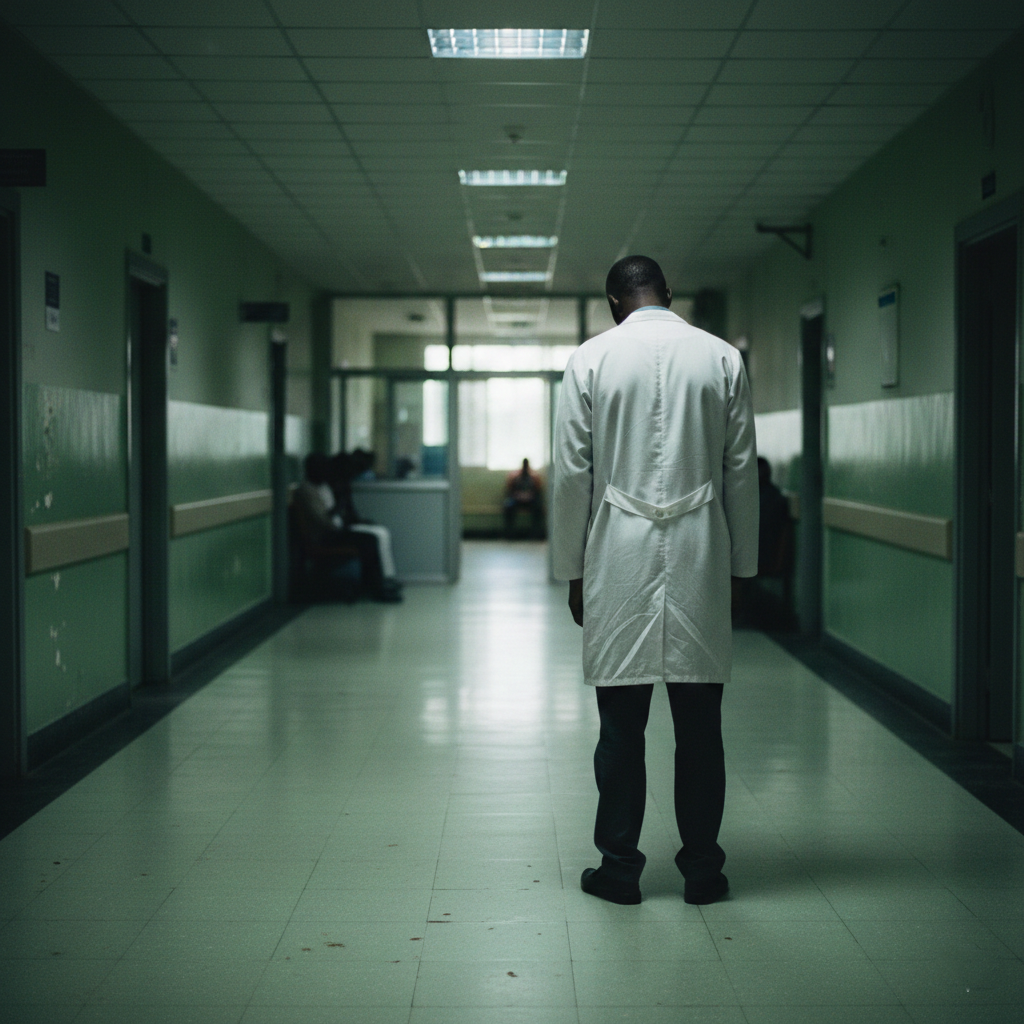
“Ei, how much longer must I wait to see the doctor?” I heard a woman shout to no one in particular. She got up, strapped her child on her back, and began strolling in the OPD aisle. The baby whimpered and kicked lightly; the shadows under the mother’s eyes seemed carved in and hollow. I wish I could approach her to help her with her baby, at least. But, as the only pediatrician on call attending to a child in distress at that moment, it remained a wish.
A nurse approached the woman and upbraided her, “Madam, you can see that we’re working. Take your time. It will be your turn soon. Please sit on the chair. You can’t be moving around like that. You people make us talk too much. Oh!”
“Herh, young woman, is it not your job to take care of us?” Another woman took up the fight. “Do you know how long we have been here?” – gesturing at the other patients in the waiting area. “The government is paying you with our taxes, and you’re there insulting us? Herh!”
By this time, the nurse had moved away, but the people in the waiting area continued murmuring. I could count about twenty-one people with different complaints.
As I scanned the room, my eyes landed on a younger woman, probably in her early thirties, seated quietly, her head against the wall and tilted upward, and her lips clenched. She was holding an old child in her bosom. The child’s head was on her shoulder. Right there, I was transported to a similar posture, twenty-five years ago, when I was nine.
I sat on my mother’s lap at the children’s OPD at Central Hospital, waiting to see a doctor. I remember I could not breathe properly, and I had lost my appetite as a result. My mother had brought me to the hospital early in the morning, hoping we would be attended to and return home so that I could sleep.
The hospital was noisy, hot, and full of activity. All the nurses were rushing, but none of them came to my mother and me. Whenever my mother approached a nurse to inquire when we would consult with the doctor, she was asked to wait a bit. I saw the disappointment on her face. And when I told her I was hungry, a single tear fell from her eye; she hadn’t brought any food because she had assumed we would leave the hospital earlier. We were finally attended to at 2pm, eight hours after we arrived.
But our woes were far from over. We waited at the hospital pharmacy for another three hours. My mother was flustered. I had never seen her lose her calm before. She fought with the pharmacist and the nurses and insulted any health worker who overtook us with a protocol prescription. I saw my mother broken by a system that was meant to heal us.
On our way home, I told her, “When I grow up, I will be a better doctor. I will treat people very fast, okay?”
She smiled, perhaps at my childish confidence. I didn’t grasp the weight of that promise then.
Here I was, in the present, at the same hospital, watching a re-enactment of my mother’s drama with different characters – different victims of the same system that plagued me as a child.
The child I was taking care of winced, snapping me back to the present.
“I’m sorry, sweetheart.” I wrapped up her treatment and headed for my desk. Just as I began entering the child’s prescription, the woman who had ranted earlier approached my desk. Her brows had come together on her forehead, but her child had fallen asleep on her back. At that moment, I wished the hospital had partitioned the children’s OPD and given the medical practitioner an office, rather than leaving the place open: I felt vulnerable.
Fortunately, she was intercepted by a nurse. “Madam, it’s not your turn yet―”
“But there’s nobody there! My child is sick―”
“Doctor!”
I sprang out of my chair at the urgency of the call. Just then, a nurse rushed in with a child in a wheelchair. He looked pale, his breath caught in his throat, eyes bulging, face contorted. There was no time to waste.
“Oxygen!” I barked, checking his pulse. There was no bed at the children’s OPD, so another nurse spread a bed sheet on the floor, and I gently placed the boy on it. By this time, we had gotten an oxygen mask on his nose, and his breaths were now coming in shallow jerks. I kept my eyes on the oxygen monitor, praying. I could hear commotion at the entrance of the OPD, but my eyes followed the waves on the monitor. As I began assessing the boy’s chest and abdomen, he heaved suddenly, gripping my hand. His eyes, wide and frightened, caught mine. Then he went limp, the monitor beeping endlessly, and the line flattening…
I checked the clock. 3:51 pm.
Men don’t cry. Doctors are familiar with death. But this pierced my soul. I checked again for a pulse, blinking fast so that the tears don’t fall, willing life into his body.
I looked up at the nurse who brought the child in and quietly shook my head. She turned to record the time I gave her and went out to call an orderly. I, still squatting by the lifeless body, covered him. Just then, a man barged into the space, wild and restless.
I stood up suddenly – thank God for agility workouts – and stopped him.
“Excuse me, sir…”
“My son!” he said, scanning the room. “Where is my son?”
We all felt the shift the moment his eyes landed on the boy on the floor. He let out a feral cry and grabbed me by my coat. “You killed him! You killed my only son!” Then he flung me aside and knelt beside the bundle on the floor. I had never felt so much like a failure in that moment.
The open OPD began to shrink. I turned away to get some air, only to run smack into the first woman with the baby. She had a condescending look. God, why won’t she sit down? I sidestepped her and headed for the door, waiting for the orderly and the nurse to return. She shouted for the whole OPD to hear, unaware of my trauma, “You killed somebody’s child. Do you know how it feels to carry a pregnancy and give birth? You people don’t have feelings. You think death is normal. Tueh.”
I couldn’t respond.
Soon, the orderly arrived with a stretcher, and we loaded the body onto it. Then, the nurse turned to the father and took down the boy’s details, after which the orderly tagged the body, and they wheeled out. The father’s wailing tore at my soul.
I had sworn the Hippocratic oath to serve and save lives. Lives have been lost in my hands after several attempts to save. The weight is never easier on the next one.
We only fold our grief neatly inside and step back into the line.






Hmmm it’s quite unfortunate that we’ve found ourselves in this kind of situation, where citizens pay taxes but are not given a well deserved treatment when it comes to the key aspect of a man’s life, HEALTH.
This is a true reality